

Facts About Friday The 13th Superstitions You Need To Know

13 Facts About Friday The 13th Superstitions You Need To Know [Updated for 2026]
Friday the 13th Superstitions have long intrigued and mystified myself and many others around the world!
Rooted in a mix of history, culture, and folklore, this day has garnered a reputation for being the most unlucky day there is.
Growing up I was constantly warned about the unlucky number 13 and the horrid luck everyone receives when a Friday 13th rolls around.
So much negativity surrounding one number, and one particular day/date.
I thought to myself, why is that?
*Disclaimer: This post contains affiliate links which means I earn a small commission if you make a qualifying purchase through these links or codes. But don’t worry, there is never any extra cost to you. As an Amazon Associate, I earn from qualifying purchases. Please read my Privacy Policy here for more info. Thank you!*
This got me curious and I just had to get into research mode, and find out some interesting facts about Friday 13th and it’s Superstitions.
So, without further ado, let’s dive in and discover some new facts about Friday the 13th together, shall we?
13 Facts About Friday The 13th Superstitions You Need To Know
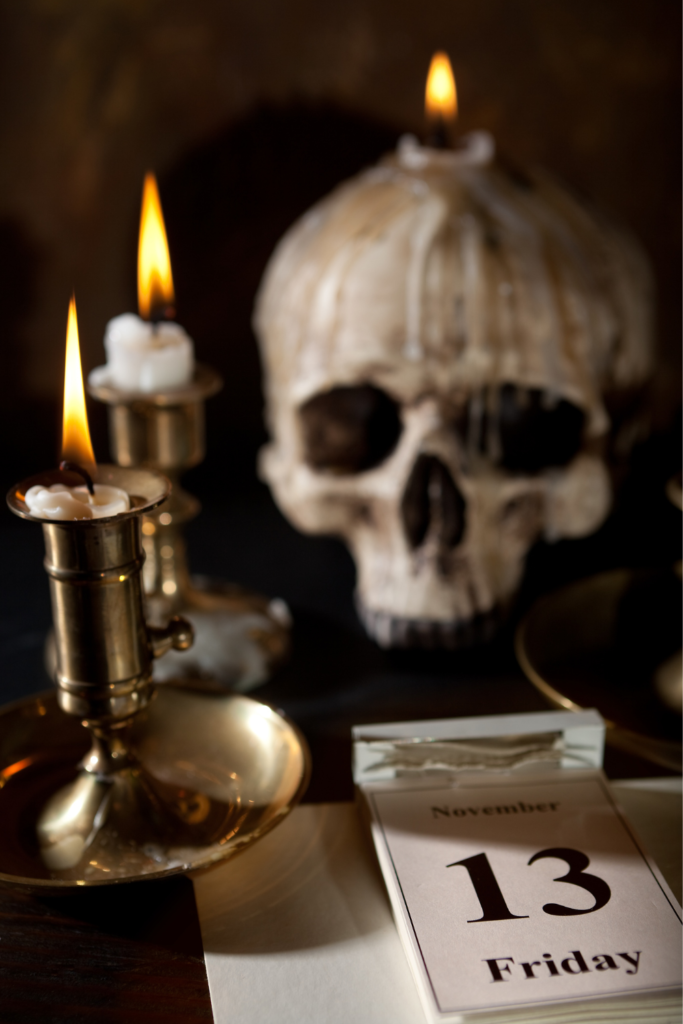
Here’s the thing about luck…you don’t know if it’s good or bad until you have some perspective.
– Alice Hoffman
Fact Number 1: The Fear of Friday 13th
Paraskevidekatriaphobia, or The Fear of Friday the 13th as its more widely known, combines two separate fears.
These two fears are that of the number 13, also known as triskaidekaphobia and the fear of Fridays.
Interrstingly, the word Paraskevidekatriaphobia originates from the word “Paraskevi” which is Greek for Friday!
Another name for this fear is “Friggatriskaidekaphobia”.
Friggatriskaidekaphobia originates from Norse mythology as the name for the Norse Goddess for Friday, is Frigg.
Fact Number 2: Biblical Connections
In my research I found that one of the earliest associations of the number 13 and bad luck happens to come from the Bible.
During the Last Supper, Judas Iscariot who was the disciple that betrayed Jesus just so happened to be the 13th guest.
Because of this connection, a lot of people believe 13 is an unlucky number.
Fact Number 3: Norse Mythology
Much like the last supper, in Norse mythology, the trickster god, Loki, was the 13th (uninvited) guest at a dinner party in Valhalla.
Loki showing up brought the total count of gods in attendance to 13, and his arrival brought nothing but misery.
All the chaos resulted in the blind god, Hodr, shooting his brother, Balder, the god of joy and gladness.
Fact Number 4: Friday’s Unlucky Reputation
Throughout history, Friday had been seen as an unlucky day.
Many people believe this is because Jesus was crucified on a Friday, a day now known as Good Friday.
But, there are even more references throughout Christianity to Friday being an “unlucky” day such as:
- The day Cain murdered his brother, Able.
- The Day Noah’s ark set sail in the Great Flood
- It’s also the day Adam and Eve ate the forbidden fruit
Fact Number 5: The Knights Templar
The Knights Templar incident happened on Friday, October 13, 1307.
During this incident hundreds of the Knights Templar were arrested and then later executed.
You’ll often see this event cited as a historical origin of Friday the 13th superstitions, although no one can be 100% sure.

Fact Number 6: Literature Influence
The fear of Friday the 13th was popularised in modern times by the 1907 novel “Friday, the Thirteenth by Thomas W. Lawson.”
The book tells the story of a stockbroker who uses the superstition to create a Wall Street panic.
This book helped to boost the superstition that Friday the 13th is an unlucky day, and catapulted this notion to the masses.
Fact Number 7: Hollywood Impact
The 1980 slasher film “Friday the 13th” further cemented the dreaded day’s association with bad luck and fear.
The movie franchise has since become iconic (one of my favourite!), perpetuating the superstition even more.
I’m sure there’s not a horror fan or otherwise out there who hasn’t heard of this movie.
Fact Number 8: Cultural Variations
Although Friday the 13th is considered unlucky in many Western cultures, it’s not got a bad rep everywhere.
In Spanish-speaking countries, Tuesday the 13th is considered the unlucky day and in Italy, it’s Friday the 17th.
Fact Number 9: Number 13 in Buildings
Due to triskaidekaphobia (the fear of the number 13), many buildings tend to skip the 13th floor entirely.
This began in the early 20th century when skyscrapers first started to be built.
Architects were concerned about fire safety on the 13th floor, and they also wanted to accommodate guests who might be superstitious about the number.
Hotels and hospitals are also often seen to avoid using the number 13 for rooms and floors to accommodate superstitious guests and patients.
Fact Number 10: Airline Superstitions
Just like architects skip the 13th floor, some airlines skip the 13th row on planes.
This practice is another nod to the widespread belief in Friday the 13th superstitions.
Airline companies do this due to the bad luck and fear associated with the number, and to accommodate guests who may be superstitious.
Fact Number 11: Financial Impact
Friday the 13th has also been reported to cause significant economic losses!
There are many estimates out there that suggest millions (£/$/€) is lost due to people avoiding travel, work, and major purchases on Friday The 13th.
Fact Number 12: Popular Culture References
Friday the 13th superstitions have made their way into various forms of popular culture, including books, movies, and TV shows over the years.
Many of these forms of content have capitalise on the fear surrounding the superstitions and Friday the 13th.
This in turn reinforces the day’s ominous reputation, and garners even more fear.
Fact Number 13: Psychological Influence
Some psychologists suggest that believing in the superstition can create a self-fulfilling prophecy where people expect bad things to happen and thus notice them more.
This means the fear of Friday the 13th someone has can actually be powerful enough to affect the behaviour and perception of that individual.
The mind is a powerful tool and focusing on the “bad luck” means our brain will look for the pattern.
So, anything “bad” that does happen on a Friday 13th will only further perpetuate the belief that it is indeed “unlucky”.
Final Thoughts on Friday The 13th Superstitions Facts
Friday the 13th superstitions stem from a rich tapestry of history, culture, and psychology.
Whether you consider the day to be genuinely unlucky or simply a quirky part of our collective consciousness, it’s clear that these beliefs have a significant impact on society.
So, next time Friday the 13th rolls around, remember that the power of the day lies as much in our minds as it does in the myths that surround it.
Tell me, are you superstitious?
Posts you may like
- 13 Superstitions For Friday 13th Everyone NEEDS to Know
- Must-Watch Horror Movies: Strong Female Leads You NEED to See


These were really cool to read about, thanks for sharing