

8 early signs of Vascular Dementia that everyone should know

AD | The 8 early signs of Vascular Dementia that everyone should know – [Updated for 2026]
Dementia is a horrible disease.
It strips someone of what makes them, them at the very end. So it’s important to know the signs and what to look for.
*Disclaimer: This post contains affiliate links which means I earn a small commission if you make a qualifying purchase through these links or codes. But don’t worry, there is never any extra cost to you. As an Amazon Associate, I earn from qualifying purchases. Please read my Privacy Policy here for more info. Thank you!*
That’s why todays post, The eight early signs of Vascular Dementia that everyone should know, is close to my heart.
I have personal experience with family members who have sadly passed with dementia and wish I knew the signs earlier.
I’m sure we would all wish that, so let’s just dive straight in, shall we?
What is Vascular Dementia?
Vascular Dementia is a common type of dementia caused by reduced blood flow to the brain.
It’s estimated to affect around 150,000 people in the UK, but for Dementia as a whole, this there are currently 850,000 people in the UK with the disease.
Vascular dementia can affect anyone, anywhere.
Although, those over the age of 45 are most often diagnosed with disease.
With so many people in the UK with the disease, there are many families who have to cope with their loved one’s health deteriorating.
It’s a heart-breaking disease, but with research for the cure well underway, the best thing that can be done right now is to continue raising awareness of the signs of Dementia and highlighting charities that are fundraising for the research into the cure.
It can affect everyone differently
Vascular Dementia can affect people in different ways, and the underlying causes to the Dementia will vary too.
Symptoms may develop over a long period of time, or they will develop suddenly, for example, after a stroke.
Country Cousins have created the infographic below which highlights the eight symptoms of early Vascular Dementia that everyone should know about and I think it’s important that we learn these signs to get our loved ones the help when they need it.
Eight early signs of Vascular Dementia that everyone should know
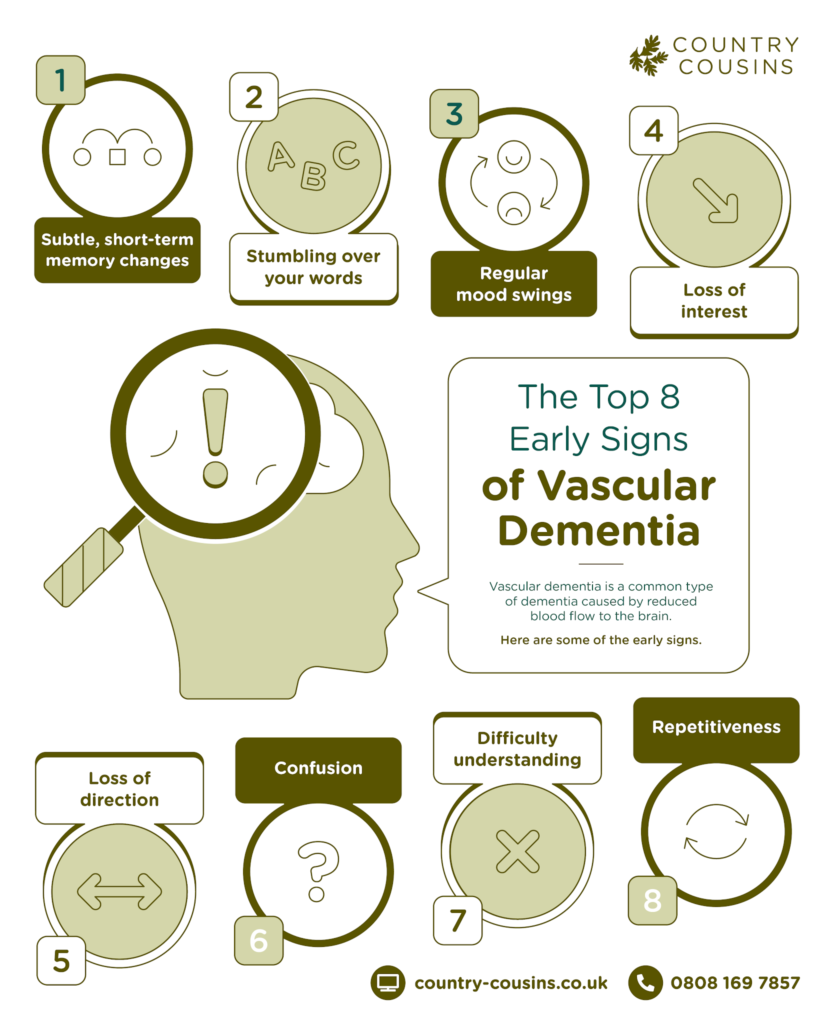
To gain a deeper understanding of Vascular Dementia, here is further description of the symptoms in the infographic:
1. Subtle short-term memory changes
In the early stages of Vascular Dementia, memory loss is subtle and usually involves short-term memory loss, rather than long-term memory loss.
This means someone with Dementia will be able to remember events that took place when they were younger.
Although they might struggle to remember where they put their house keys, or what they had for dinner the night before.
2. Stumbling over your words
This is particularly frustrating for people with Dementia.
Because they know what they want to say, but they have difficulty communicating their thoughts.
Therefore, having a fluid conversation with someone who has Dementia can be challenging, and it may take longer than a normal conversation would.
3. Regular mood swings
Regular mood swings are very common for people with Dementia, especially in the early stages.
Not being able to communicate properly and forgetting what you have for breakfast is understandably very frustrating for the individual.
If you have Dementia, you might not notice these mood swings yourself. But it will be obvious for friends and family.
Along with mood swings, a person with Dementia might have a complete personality change.
Someone who was once confident and outgoing might become shy and quiet.
RELATED: Portable Caregiver Pager Wireless Call Button for Elderly
4. Loss of interest
Another common symptom in the early stages of Dementia is apathy.
This means the individual is losing interest in their everyday activities and hobbies.
They might not even want to see their friends or family.
5. Loss of direction
A sense of direction starts to deteriorate in the onset of Dementia.
This might mean not being able to recognise regular journeys in the car or certain familiar landmarks.
It also becomes a struggle to follow directions, say on a map or on a phone.
6. Confusion
One of the most well-known symptoms is confusion.
When someone starts to forget things, and their personality is changing frequently, confusion will start to set in.
Because of this, someone with Dementia may start to forget familiar faces and they won’t be able to interact with people the same anymore.
7. Difficulty understanding
Another classic early symptom is not understanding things and not being able to follow steps or storylines.
For example, it will become very difficult to watch TV and follow the storyline, or in when talking to a friend, it will become difficult to engage in fluid conversation.
8. Repetitiveness
Memory loss and behaviour changes in the early stages tend to cause repetitiveness.
This means a person might continuously repeat daily tasks, such as brushing their hair, making their bed, or tidying the house.
When in engaging in conversation, someone with dementia might repeatedly ask the same question.
It’s important to note that forgetfulness doesn’t always mean someone has dementia, but this doesn’t mean you should ignore the symptoms.

Speak to a doctor if signs are present!
If you know someone who is experiencing the eight early signs mentioned above, then getting them to talk to a doctor is important.
Making sure people know the symptoms stated in the infographic will hopefully help in encouraging them to get help.
The symptoms above are not to be ignored and even if you think you’re just ‘getting confused’ sometimes or have ‘difficulty understanding things’ every now and then, these are not things to dismiss.
RELATED: Healthcare M01278 Overbed and Chair Table – Divan Style, Tilting and Adjustable
You can take steps to help
Although there is a no set cure for dementia, there are numerous steps that can be taken to improve cognitive health such as:
- Memory games
- Puzzles
- Being active
- Implementing a healthy lifestyle.
There are also various research projects that can be joined to aid in the studies being done to try and understand dementia further and develop further treatments.
Dementia Care Services
Country Cousins understands how complex dementia is, and families all over the UK rely on their dementia home care services as opposed to placing their loved ones within residential care homes.
The carers at Cousins Cousins will provide companionship, meal preparation, housework, domestic administration, recreational support, and daily errands.
So, you can be rest assured that your family member will be truly cared for.
I can’t help but think how much Country Cousins could have helped my granddad, so it’s definitely a service that is vital to those who may need it.
If you want to learn more about Country Cousins Dementia live-in care you can call them on 01293 224 706.
RELATED: Véfaîî Newest Dementia Clock 2.0 with Auto DST and 20 Custom Reminders
Posts you may like
- How to Protect Yourself From the Hidden Costs of Being an Adult
- How to use Crutches | 4 Top Tips for Using Crutches


This Blog Post Was Created By A Human (No AI)





Dementia truly is horrid. We missed a lot of the early signs with my grandmother on my mum's side, and it was only years later when we were looking back on them that they were so obvious. Another early sign is a loss or change of taste, which makes a lot of sense because my grandmother suddenly switched to putting huge amounts of salt in her food. I just wish we'd known the signs sooner as live-in care would have been a huge help for her and my Grandfather.Em xx
Just saw your blog my father is in memory care I’m a few miles away so I try to visit as much as possible and feel bad when I take a day to do whatever I need to do ..or play in garden. Dad loves being outside and walking but there’s not enough staff to take him for walks and he has rammed his Walker into door and staff to get out. My mom was in hospic last year and passed in Sept. Hard road to navigate I saw a sign that read I go into my garden to lose my mind and find my soul. Stay positive hard daughter went to a sensory class and came out crying.. shes raising $ to help find a cure and is a voice to raise awareness so we have more compassion and patience ..it’s a bumpy road but I’m learning. Never too old for homework. God Bless